Jose Montalvo · Systems & production records

Turning it into reports that trigger action

The same numbers, entered once, coming back out as something somebody has to act on.

14

Tin: entry screen → weekly summary → usage history

Wieland Metal Services · Operations Manager · 2025–2026

What it is
An entry screen the floor fills in, a weekly summary it builds, and the running history underneath that makes the forecast possible.
Why it existed
Tin is the expensive input. Nobody could say what we had, what we were burning, or when we'd run out — and the price moves.
What changed
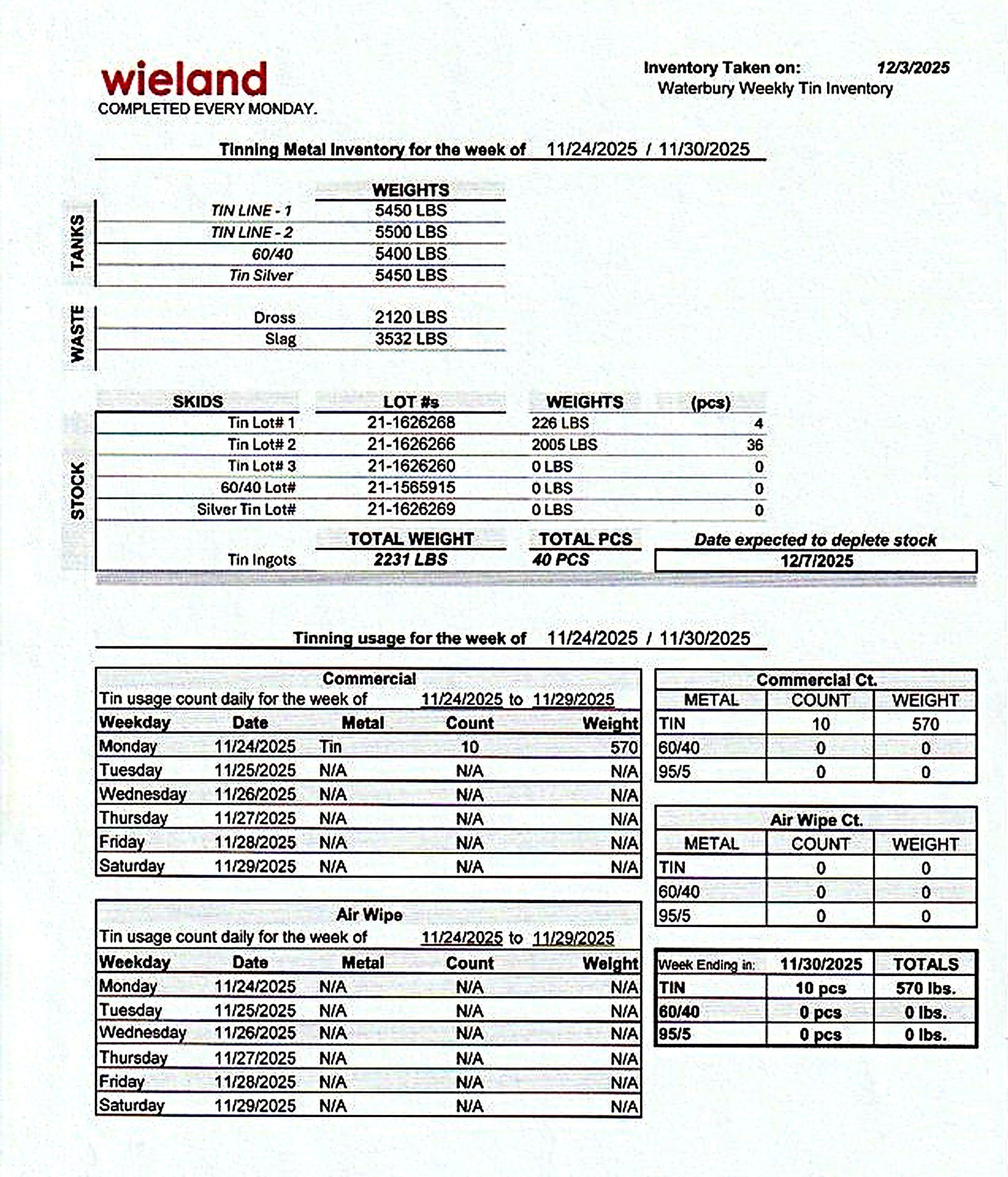
A weekly number for tank levels, waste, stock lots and ingots, and a printed date for when stock runs out. That date is what let me buy tin against the market instead of against a panic.
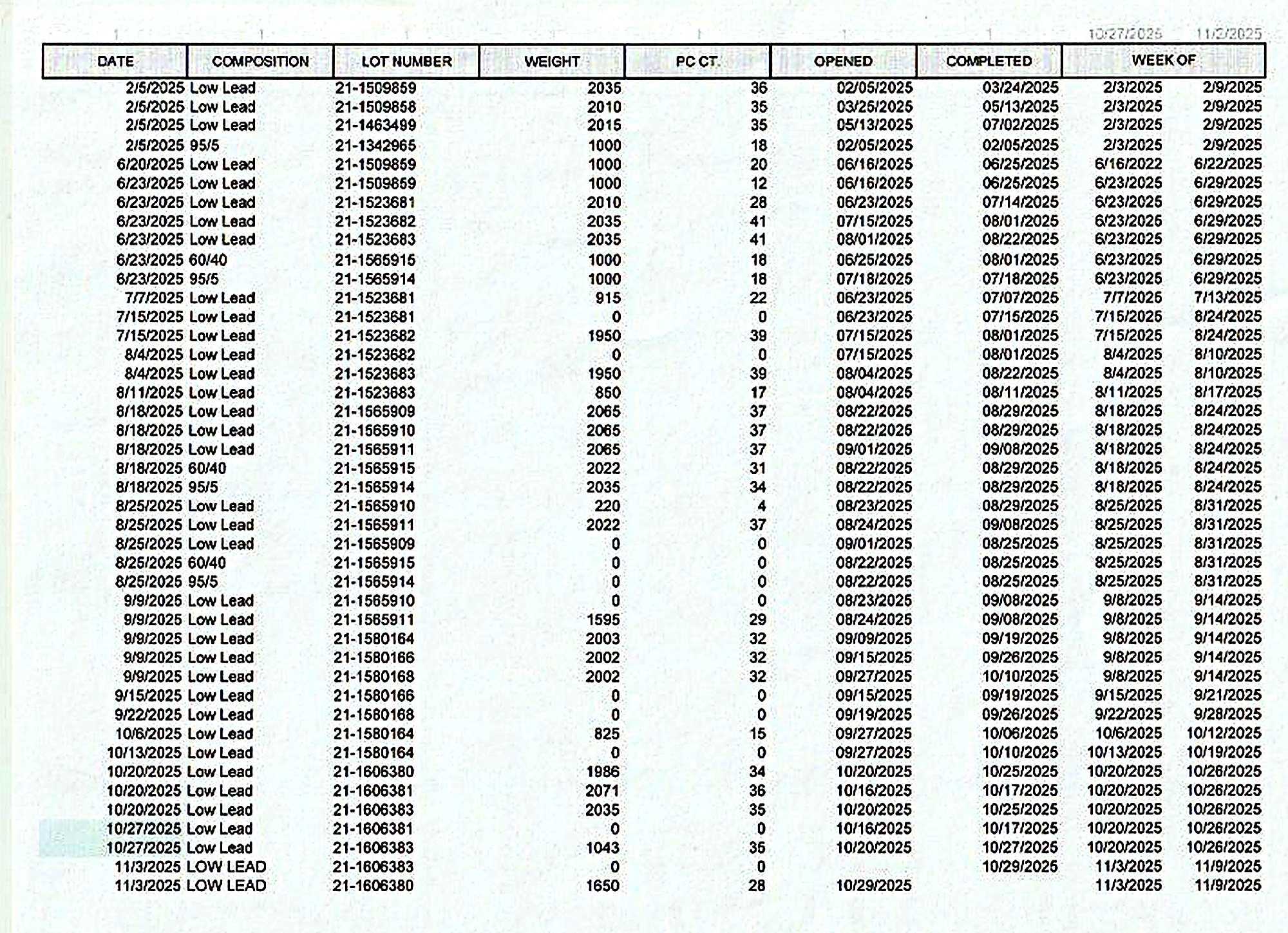
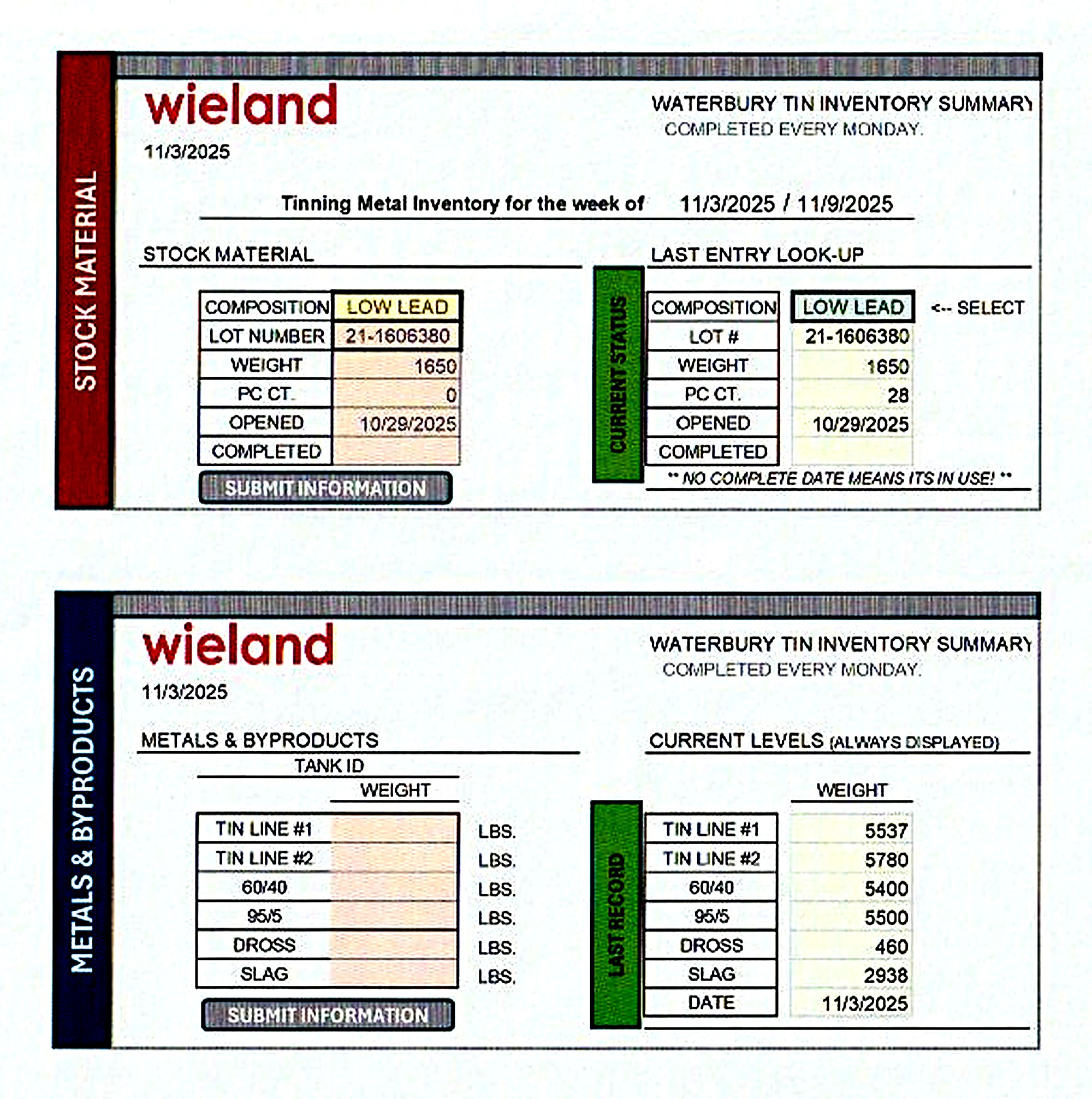
Tin inventory data entry screens with submit buttonsWeekly tin inventory and usage summaryRunning history of every tin lot opened and completed
The entry screens — one for stock material, one for metals and byproducts — with a submit button and a last-entry look-up so nobody has to go find the previous sheet. The weekly summary totals the four tanks, dross and slag, and prints the date stock depletes. The third page is the history behind it: every lot, composition, weight, piece count, opened and completed, February through November.Tap a page to open it full size
15

The re-order list writes itself

Wieland Metal Services · Operations Manager · 2025–2026

What it is
A weekly purchasing list generated from the counts — on-hand against re-order limit, only the items that are actually at or below.
Why it existed
Purchasing was being driven by whoever shouted. The counts already held the answer; nobody was turning them into an order.
What changed
Counting on Monday produced the buy list on Monday. Same data, entered once, no second spreadsheet to maintain.
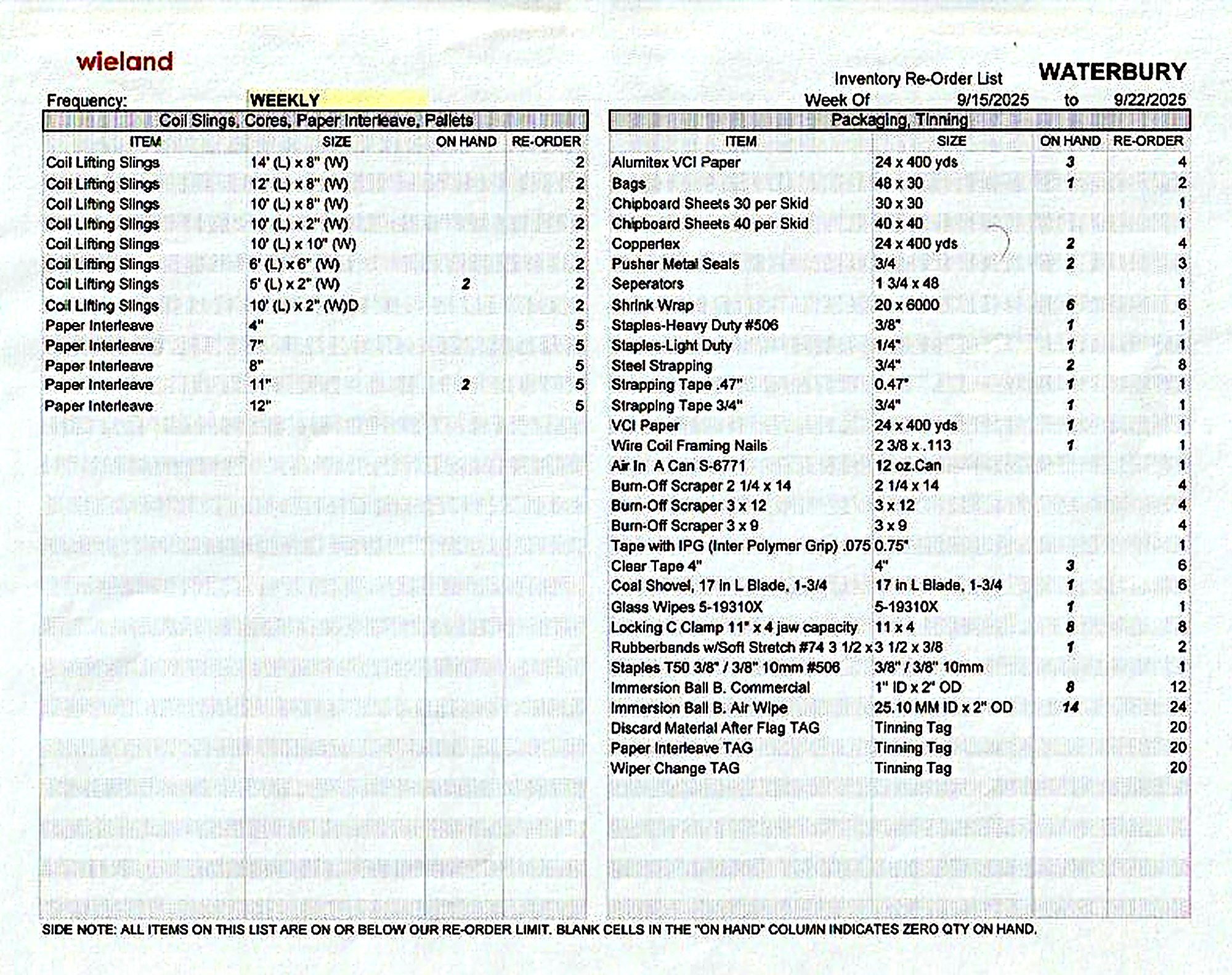
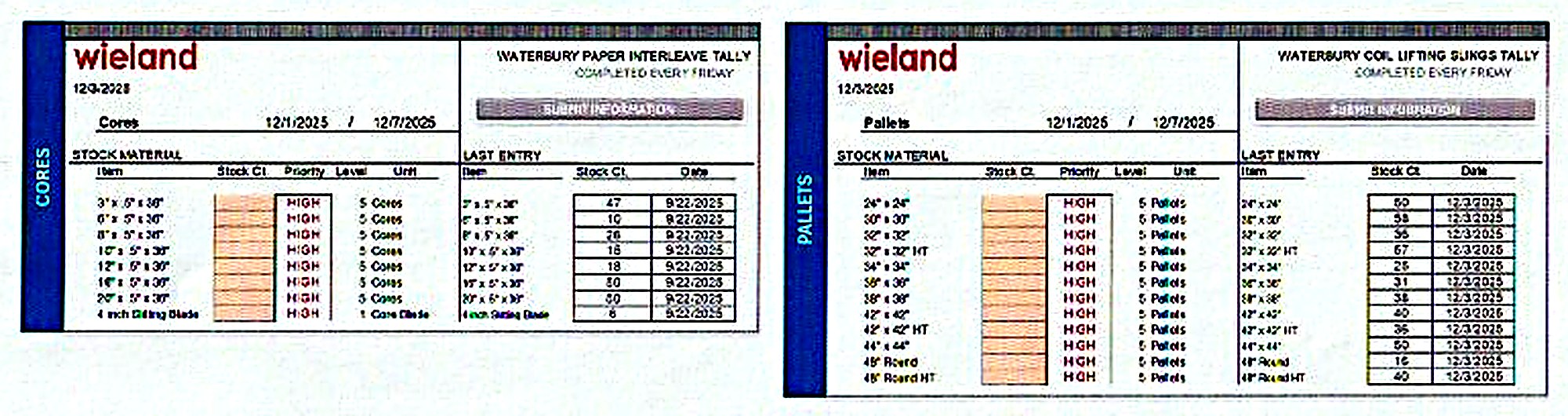
Weekly inventory re-order list generated from the countsCores and pallets stock tally with reorder priority
The re-order list for the week with the rule stated right on it: a blank cell in the On Hand column means zero on hand. The second page is one of the category tallies feeding it — cores and pallets, with priority, level and the date of the last entry.Tap a page to open it full size
16

Count it on one side, buy it on the other

Wieland Metal Services · Operations Manager · 2025–2026

What it is
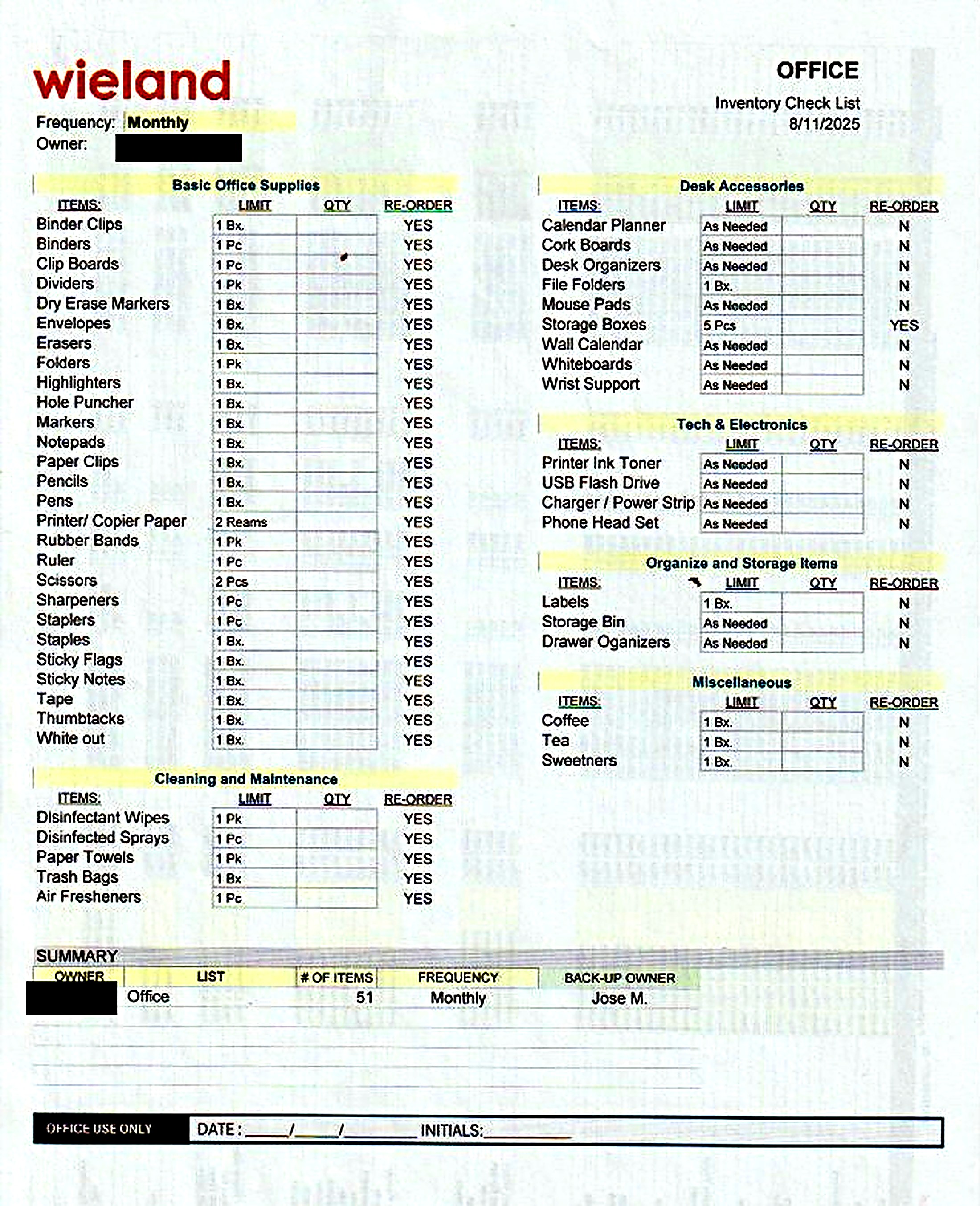
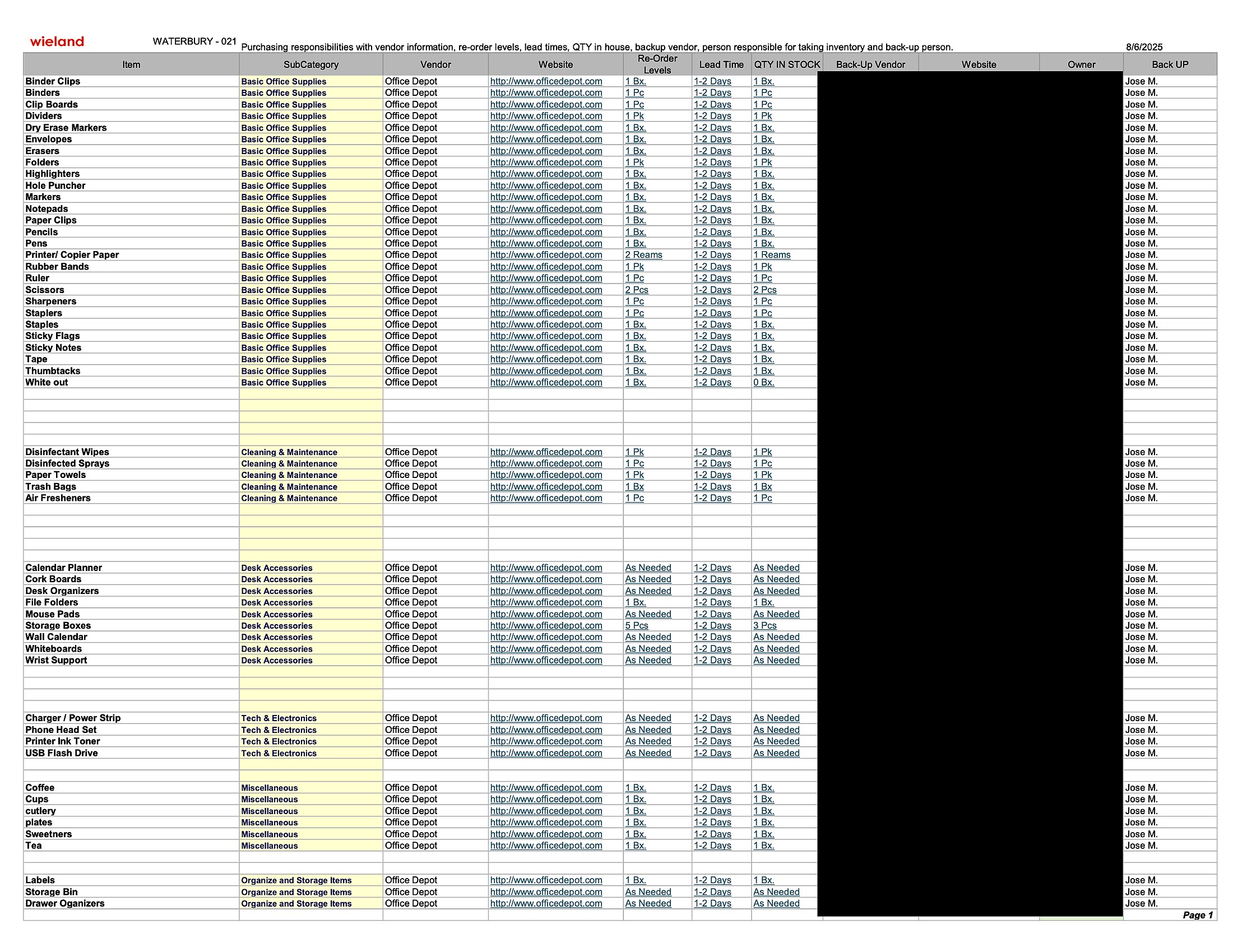
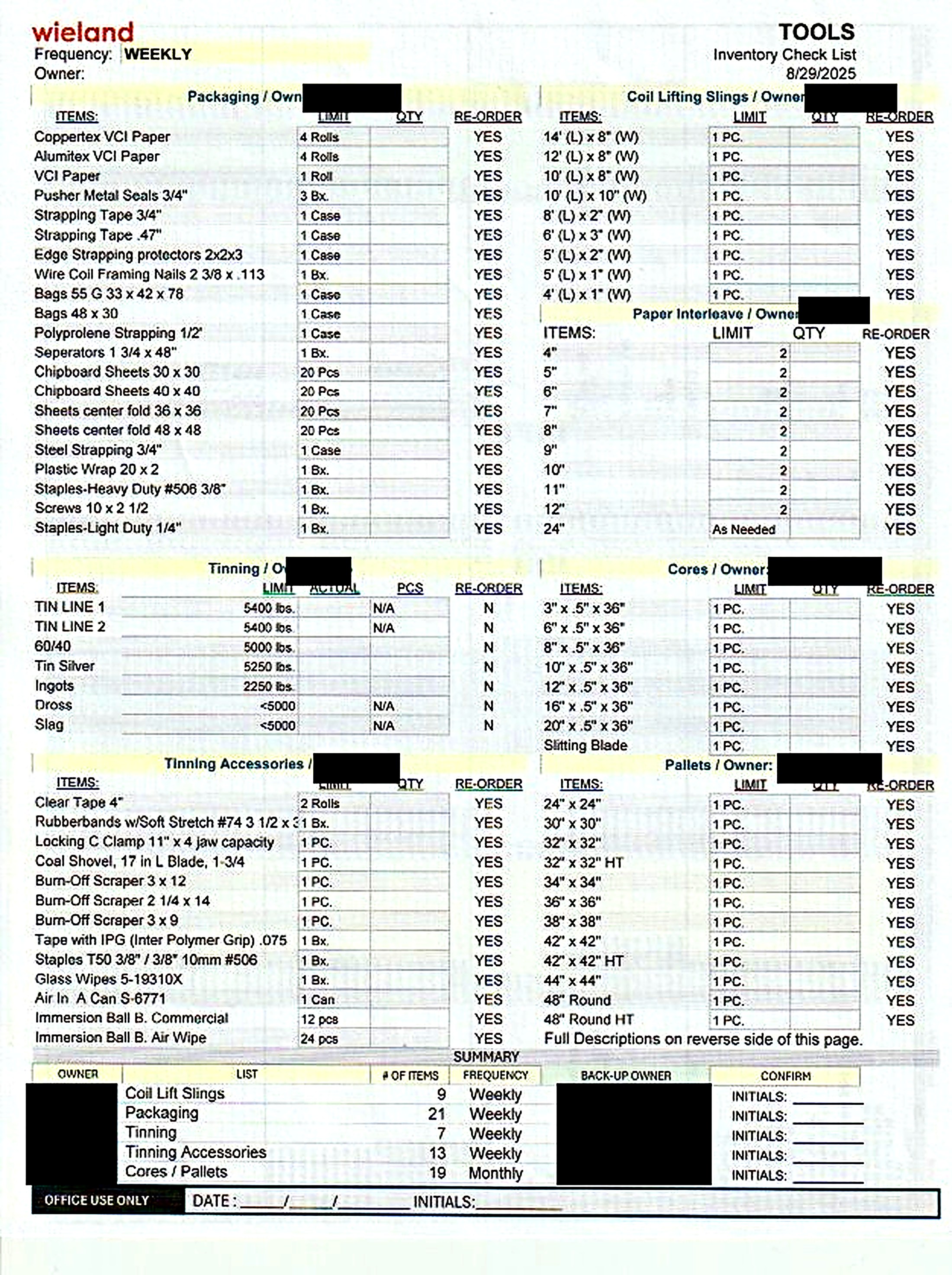
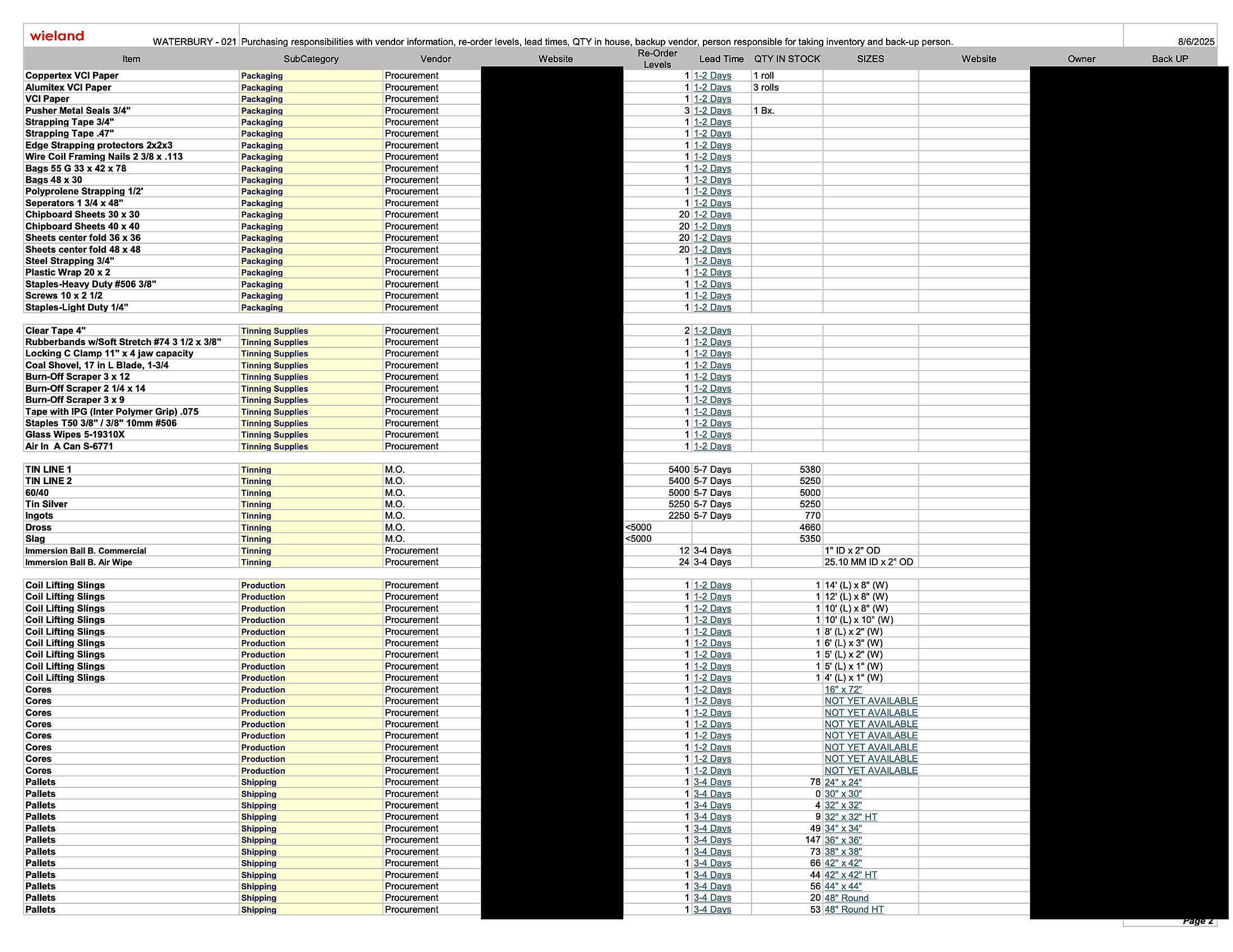
One sheet, printed two-sided. The front is the inventory count — every item with its limit, what's on hand, and whether it's due to re-order. The back is where to get it: vendor, lead time, back-up vendor, and the person responsible with a named back-up.
Why it existed
The count and the ordering lived in two different places and two different heads. Whoever did the counting still had to go find somebody who knew who the vendor was.
What changed
Count the front, flip it over, place the order. Lead time sits next to the re-order level, so the trigger point is a decision instead of a guess — five to seven days on tin is a very different number from one to two days on strapping.
Office inventory check list, side oneOffice purchasing responsibilities, side twoTools and production inventory check list, side oneTools and production purchasing responsibilities, side two
Two of these sheets, front and back. Top row is the office list: 51 items counted monthly on the front, and on the back every one of them with a vendor, a website, a re-order level, a lead time, what's in stock and a back-up vendor. Bottom row is the same sheet for the floor — packaging, tinning supplies, tinning metals, production and shipping, with tin running five to seven days where strapping runs one to two. The front of that one is the weekly count sheet under “At the machine.” Employee names and internal email addresses blacked out — except the back-up column, which is me.Tap a page to open it full size
17

A Kanban on pallets

Wieland Metal Services · Operations Manager · 2025–2026

What it is
A Kanban system on pallet inventory — the stack itself signals when to order, instead of waiting for a weekly count to notice it is low.
Why it existed
Pallets are used by every department and nothing ships without them, so running short doesn't hold up one order, it holds up whatever is on the truck that day. The custom sizes are worse again: they cost more and they take longer to arrive.
What changed
Pallets stopped being the thing that held up a shipment. The signal sits where the pallets are, so it gets seen by the people using them rather than found in a spreadsheet on Monday — and the custom sizes get ordered far enough ahead to land before they're needed instead of at rush cost.
18

What's in queue — plant, machine and customer

Wieland Metal Services · Operations Manager · 2025–2026

What it is
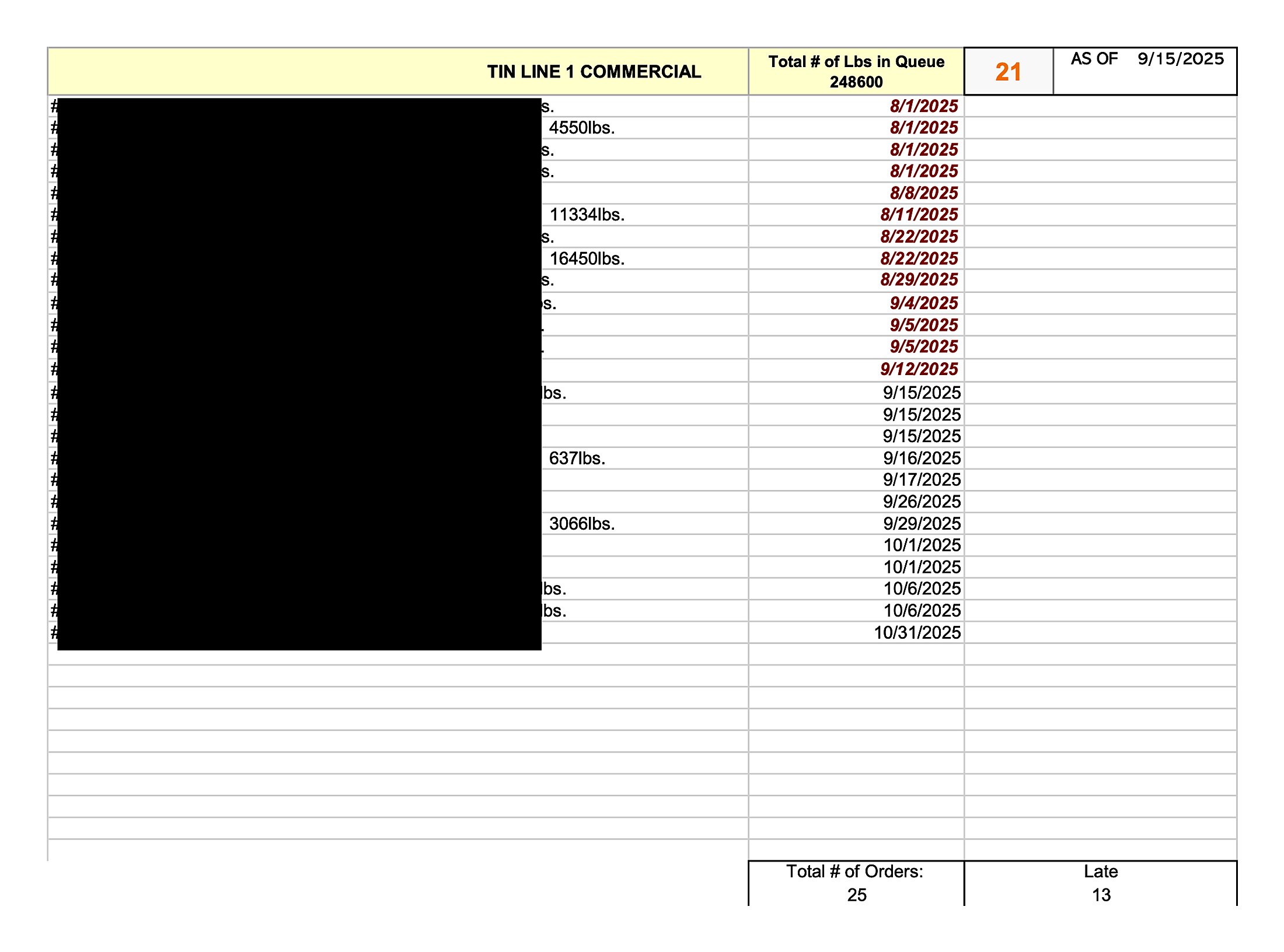
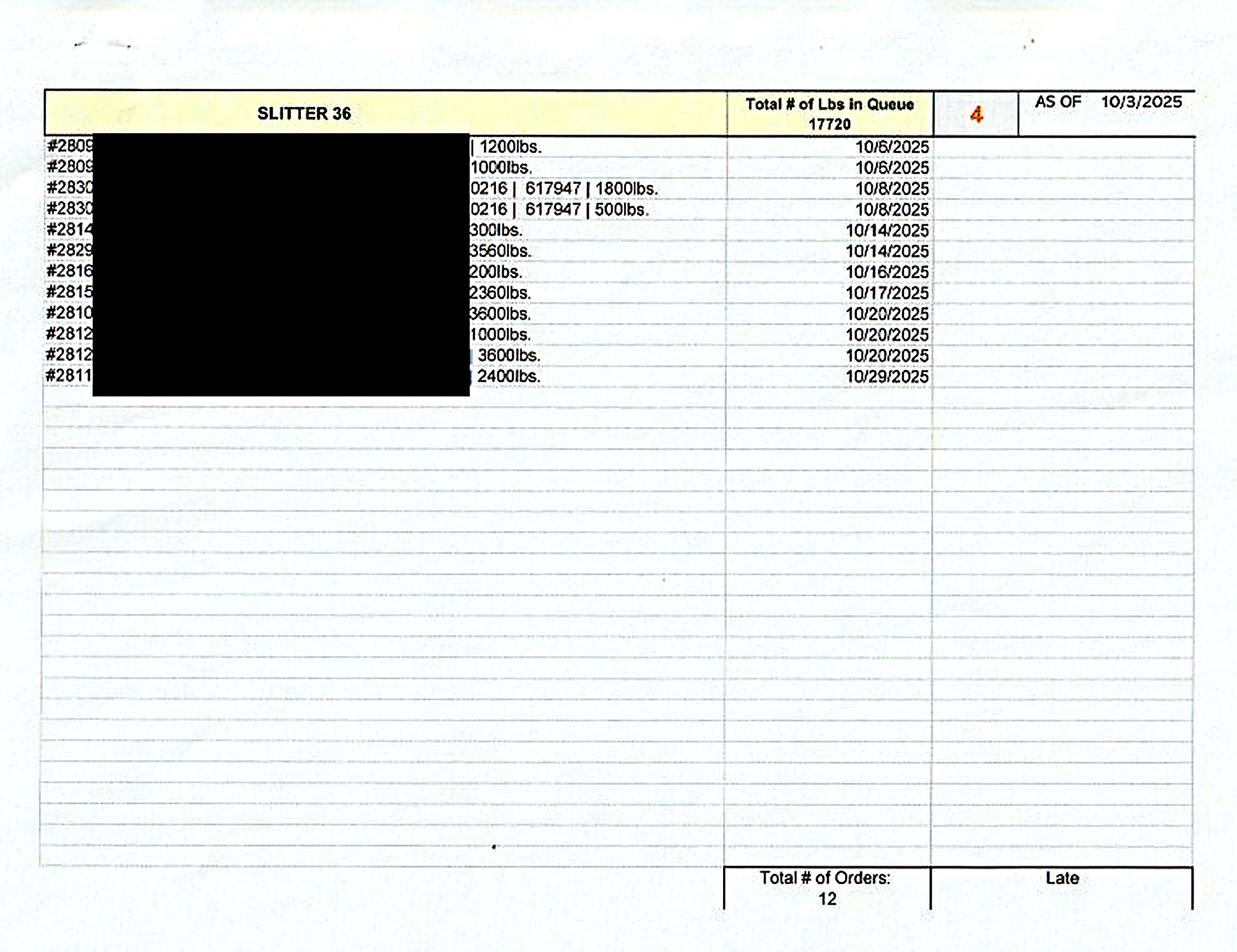
One page for the whole plant — orders, lates, pounds in queue and days to zero, cut three ways: by machine, by department and by customer — and behind it a sheet per machine listing the actual orders, colour-coded red for late and yellow for bumped up.
Why it existed
"How are we doing on Tin Line 1?" was a twenty-minute answer that depended on who you asked.
What changed
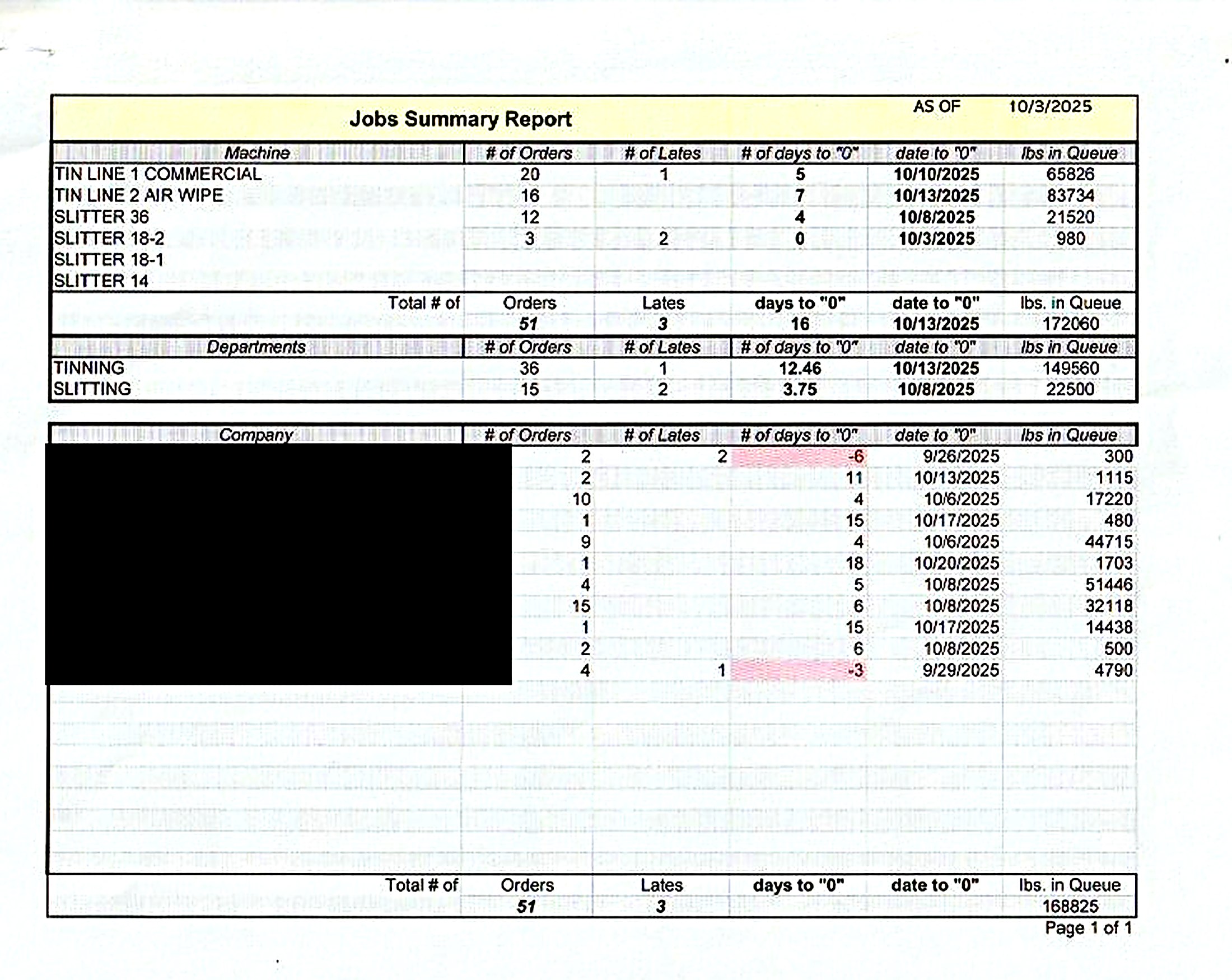
A number instead of an opinion. "Days to zero" is the one that mattered: 16 days to clear the plant, 12.5 of them tinning and 3.75 slitting, so I knew which department needed the overtime before anybody asked for it.
Jobs Summary Report: queue by machine, by department and by customerTin Line 1 order queue with total pounds, order count and late countYoder 36 slitter order queue
The master report first: six machines, two departments and eleven customers, each with orders, lates, pounds in queue and the date the queue clears — 51 orders, 3 late, 172,060 lbs, zero by 10/13. Then Tin Line 1 in detail, where red means the order is late and needs an update going back to the customer and yellow means it got bumped up and is now high priority — a decision that comes out of the spot meeting, which is the next card. Then the Yoder 36 slitter; there is one of these for every line and slitter. Customer names blacked out.Tap a page to open it full size
19

The spot meeting — hot jobs, twice a week

Wieland Metal Services · Operations Manager · 2025–2026

What it is
A standing twice-weekly meeting, fifteen to thirty minutes, on hot jobs only — an order that's been upgraded to high priority, or one coming in that we need to sit down and decide whether to bump up in production. Also new customers, and special packaging, shipping or processing requests. Led by the Production Coordinator; I set it up and wrote the agenda.
Why it existed
Orders were getting bumped up by whoever heard about them first, which means something else quietly moved down and nobody decided that. And the customer found out where their order stood by calling to ask.
What changed
Bumping an order became a decision made in a room with scheduling, production and shipping in it, not a favour done at a desk. Every hot job leaves with a current status, an owner on any follow-up, and a note that can go to the customer the same day — and the yellow rows on the queue report are what comes out of it.

Typical agenda

  1. Welcome and a quick recap of the hot job list
  2. Status updates from the team on each open order
  3. Expedited requests, and any change in production scope
  4. Packaging and shipping requirements for current orders
  5. Risks, blockers, and decisions that need making
  6. Action items and owners
  7. Wrap up and confirm the next meeting

Who is in the room

  • Production Coordinator — meeting lead
  • Production leads and supervisors
  • Scheduling and planning
  • Packaging and shipping coordinators
  • Customer-facing roles as needed

What comes out of it

  • An updated status on every hot job
  • A decision on each expedited timeline or scope change
  • A named owner on every follow-up action
  • An updated note to the customer where one is needed

The agenda as I circulated it to the team.
20

Finding material by address

Wieland Metal Services · Operations Manager · 2025–2026

What it is
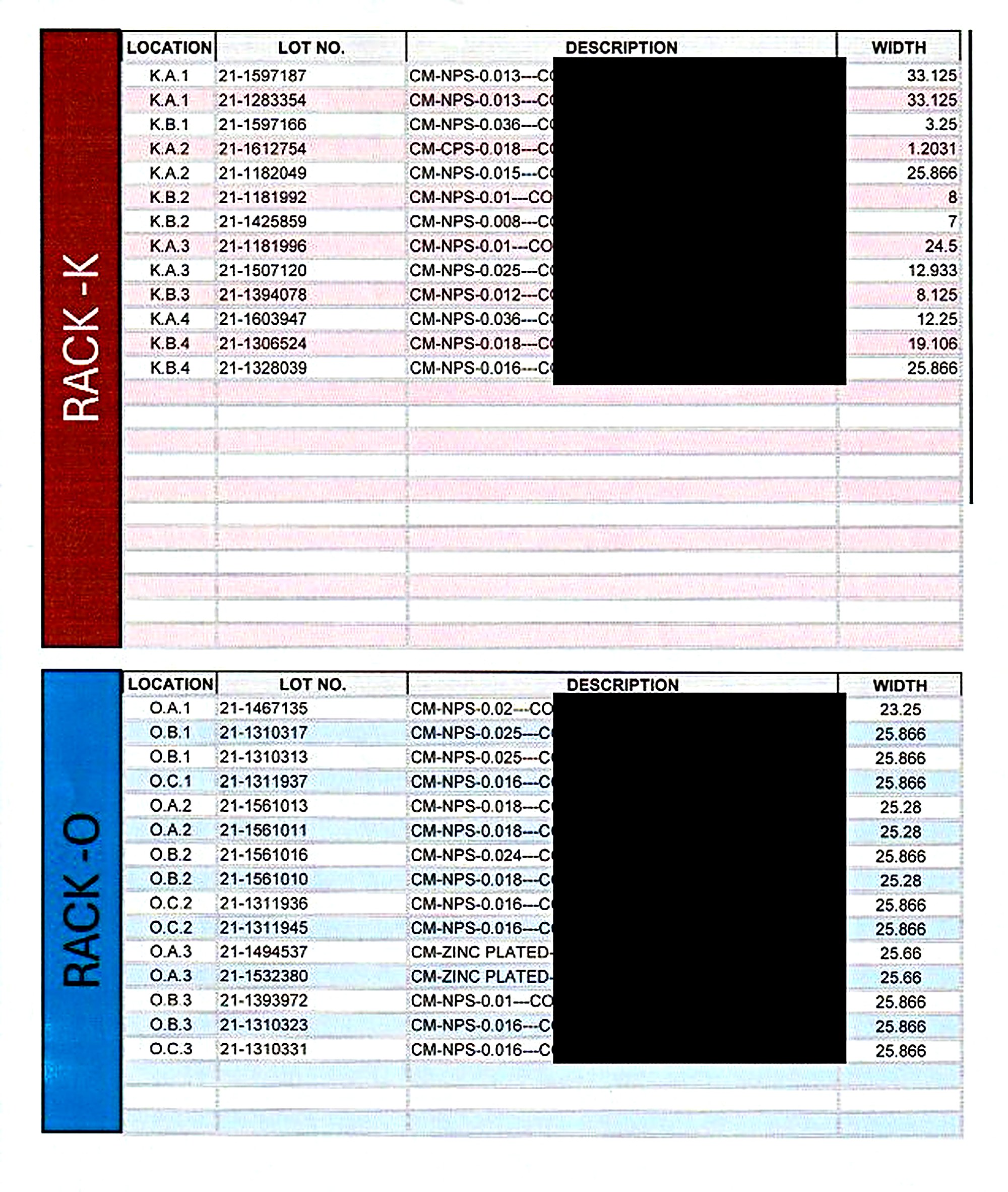
A location scheme built with IT — every rack position gets an address, every coil gets put at one, and the report says what's where.
Why it existed
People were walking the building looking for material, and paid hours were going into the search.
What changed
Material is found by address instead of memory, the report reads the same way the racks are marked, and the annual physical count stopped being a scramble.
Rack location report by position
Rack K and rack O, position by position — K.A.1, K.B.2 and so on — with what sits in each and its width. The colours aren't decoration: they match the rack identifiers in the warehouse, so the sheet looks like the aisle you're standing in. Customer names blacked out.Tap the page to open it full size